Product 1
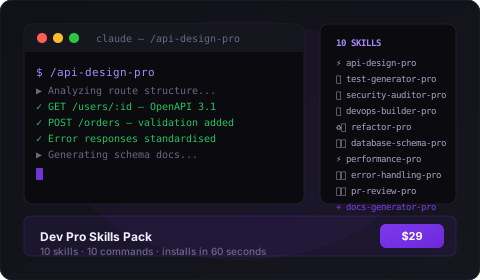
Dev Pro Skills Pack
10 expert skills + 10 slash commands. One install. Every project.
Skills are Claude Code's plugin system. Run /security-audit and Claude does a full OWASP Top 10 review. Run /gen-tests for a complete test suite. Each skill embeds a professional engineering framework — not a generic prompt.
Skills included
- api-design-pro — REST/GraphQL design with OpenAPI 3.1
- test-generator-pro — Jest, Vitest, pytest, Go test
- security-auditor-pro — OWASP Top 10, severity ratings
- devops-builder-pro — Dockerfile, CI/CD, GitHub Actions
- refactor-pro — SOLID patterns, code smell detection
- database-schema-pro — DDL, indexes, N+1 fixes, migrations
- performance-pro — Bottleneck analysis, caching strategies
- error-handling-pro — Custom error classes, structured logging
- pr-review-pro — BLOCK/SUGGEST/NIT tiered review
- docs-generator-pro — JSDoc, README, CHANGELOG
What's included
- 10 SKILL.md files (install to ~/.claude/skills/)
- 10 matching slash command files
- plugin.json manifest
- Step-by-step install guide
Product 2
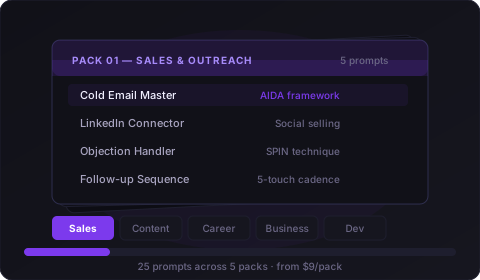
Prompt Packs
25 expert-grade AI prompts across 5 domains.
A good prompt is a professional framework embedded in text. Each of these 25 prompts has the framework built in — the role, the process, the output format. Drop in your context and get expert-level output from any AI tool.
- Cold Email Master — AIDA framework, personalisation variables, A/B subject lines
- LinkedIn Outreach — connection request + follow-up sequence, social selling structure
- Objection Handler — SPIN technique, reframe scripts for 10 common objections
- Follow-up Sequence — 5-touch cadence with escalating value propositions
- Sales Call Prep — discovery questions, pain mapping, next-step commitment framing
- YouTube Script Writer — hook, body, CTA structure; retention-optimised pacing
- Newsletter Writer — story-lead format, one big idea, scannable layout
- Blog Post Engine — SEO-aware outline, intro hook, section structure, meta copy
- Viral Hooks Generator — 10 hook formulas; curiosity, contrast, and controversy patterns
- Social Media Calendar — 30-day content plan across platforms, repurposing map
- Cover Letter Writer — role-specific narrative, achievement framing, ATS-safe format
- Performance Review — self-assessment with impact metrics, promotion-ready language
- Interview Coach — STAR-method answers, common questions, tone calibration
- Salary Negotiator — market research framing, counter-offer scripts, walk-away prep
- LinkedIn Profile Optimizer — headline, about, experience sections; keyword-rich rewrite
- Startup Idea Validator — problem/solution fit, ICP definition, kill-criteria checklist
- Competitive Analysis — 2×2 positioning map, moat assessment, gap identification
- Pricing Strategy — value-based tiers, anchoring, willingness-to-pay framing
- Investor Pitch Coach — 10-slide narrative, objection prep, traction framing
- Business Plan Advisor — executive summary, market sizing, financial assumptions
- Code Explainer — plain-English breakdown with mental model, line-by-line on request
- Architecture Advisor — trade-off analysis, system diagram description, decision record
- Bug Detective — hypothesis-driven root cause, reproduction steps, fix verification
- Technical Interviewer — realistic questions + rubric for any stack or level
- System Design Coach — scalability walkthrough, bottleneck identification, trade-offs
Works with Claude, ChatGPT, Gemini, and any AI chat tool.
Product 3
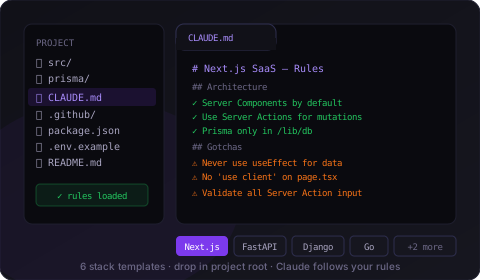
CLAUDE.md Pro Templates
Teach Claude your codebase before you write the first line.
CLAUDE.md is the file Claude Code reads at the start of every session. Drop one of these into your project root and Claude knows your architecture rules, naming conventions, and the non-obvious gotchas for your stack — without re-explaining every session.
Templates included
- Next.js 15 SaaS — App Router, Prisma, Server Actions, Tailwind v4
- FastAPI Python — SQLAlchemy 2 async, Pydantic v2, Alembic
- Django Monolith — DRF, Celery, service layer architecture
- Go API — Chi router, dependency inversion, table-driven tests
- React Native — Expo Router, React Query, FlatList performance
- Express.js — Express 5, Zod validation, Pino logging, Prisma
Each template covers
- Folder structure with explanations
- Architecture rules Claude must follow
- 8 non-obvious gotchas for the stack
- Exact commands to run
- What to avoid and why
Product 4

Hook Libraries
17 pre-built Claude Code hooks. Guardrails that run automatically.
Hooks are shell scripts that run at key points in Claude's workflow — before a tool call, after a tool call, on stop. They block dangerous operations, enforce quality, and send notifications. Most developers have never written one. These 17 pre-built hooks give you that power with no bash scripting required.
- block-dangerous-rm — intercepts any
rm -rftargeting source directories; requires explicit confirmation - block-env-writes — prevents Claude writing to
.env,.env.local, or any secrets file - block-force-push — blocks
git push --forceto main/master; warns on all force pushes - secret-scanner — scans file writes for API keys, tokens, and credential patterns before saving
- prod-db-guard — detects production database connection strings and blocks destructive SQL commands
- auto-lint — runs ESLint/Prettier/Ruff automatically after every file write; fails fast on errors
- auto-test — detects the companion test file and runs it after source file changes
- console-log-blocker — warns when
console.log/print()debug statements are committed to non-dev files - dependency-audit — runs
npm audit/pip-auditwhenever a lockfile changes; blocks on critical CVEs - migration-safety — blocks edits to existing migration files; enforces create-new-migration discipline
- branch-protection — blocks direct commits to main/master; prompts Claude to create a feature branch
- conventional-commit — validates commit messages against Conventional Commits spec; rejects non-conforming messages
- pre-commit-tests — runs the full test suite before every commit; blocks commit on failure
- session-changelog — appends a summary of all files changed in the session to
CHANGELOG.mdon stop
- desktop-notification — sends a macOS/Linux system notification when Claude finishes or stops; includes session summary
- slack-webhook — posts a Slack message with files changed, tools used, and outcome when the session ends
- token-cost-tracker — logs token usage and estimated cost per session to a local CSV; running total in terminal
Install scope
- Safety Guard: global (~/.claude/) — every project
- Git Workflow: global — any repo Claude touches
- Quality Enforcer: per-project (auto-detects stack)
- Notifications: global — any session
Product 5
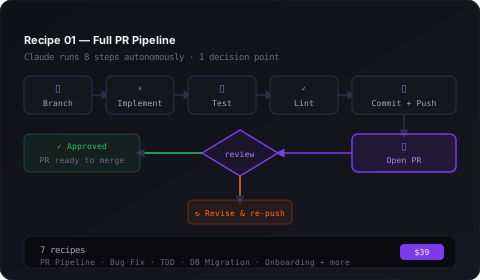
Workflow Recipes
One prompt. 15 autonomous steps. One decision point.
Each recipe is a copy-paste starter prompt that sends Claude on a multi-step autonomous workflow — pausing only at the one moment where your judgement adds real value. Tasks that take 30–90 minutes of back-and-forth get done in one focused session.
The 7 recipes
- Full PR Pipeline — branch → implement → test → lint → commit → push → open PR
- Dependency Upgrade — audit → classify → upgrade by batch → fix → security scan
- New Feature (TDD) — test plan → RED → GREEN → REFACTOR → integrate
- Bug Fix Workflow — hypotheses → regression test → fix → full suite
- Code Review Prep — BLOCK/SUGGEST/NIT self-review + PR description + confidence rating
- DB Migration — impact analysis → migration + rollback → code updates → safety checklist
- Codebase Onboarding — full project map → health report → CODEBASE.md generated
Each recipe includes
- Workflow table (every step documented)
- Copy-paste starter prompt
- Decision point guide
- CLAUDE.md snippet for your project
- Expected output checklist
Product 6
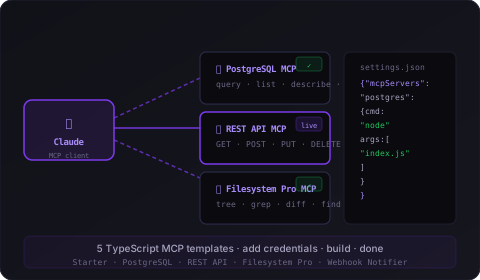
MCP Server Templates
Give Claude direct access to your database, API, and tools.
MCP (Model Context Protocol) lets Claude talk directly to external systems. Set up one of these servers and Claude can query your PostgreSQL database, call your internal API, search your file system, or send Slack notifications — all from within a Claude Code session. Fill in credentials, build, add one JSON block to settings, done.
The 5 templates
- Starter Boilerplate — correct TypeScript foundation: error handling, stdio transport, patterns
- PostgreSQL Server — query, list tables, describe schema, EXPLAIN ANALYZE; read-only mode built in
- REST API Wrapper — GET/POST/PUT/PATCH/DELETE for any REST API; configurable auth headers
- Filesystem Pro — tree, grep, diff, stats, find; all path-sandboxed to your project
- Webhook Notifier — Slack (plain + Block Kit), Discord (plain + embeds), any webhook
Each template includes
- Complete TypeScript project (src + tsconfig)
- package.json with all dependencies
- .env.example with all options documented
- Settings JSON snippet for Claude Code
- README with setup and usage examples
Product 7
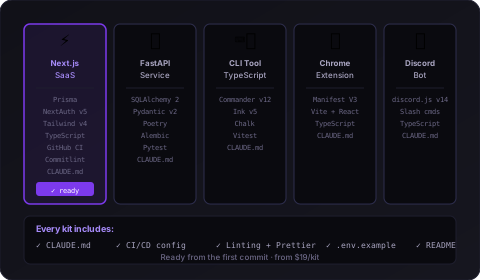
Terminal AI Starter Kits
Start your next project in 5 minutes, not 2 hours.
The first hour of any project is the most wasteful hour in development. Installing, configuring linting, setting up CI, writing CLAUDE.md — before writing a line of what you're actually building. These kits skip that hour. Every kit has a CLAUDE.md tuned to its stack so Claude understands the project from your first prompt.
The 5 kits
- Next.js SaaS — Next.js 15, Prisma 6, NextAuth v5, Tailwind v4, Vitest, CI
- FastAPI Service — FastAPI 0.115, SQLAlchemy 2 async, Pydantic v2, Poetry, Ruff, mypy, CI
- CLI Tool — Commander v12, Ink v5, Chalk, TypeScript ESM, Vitest
- Chrome Extension — Manifest V3, Vite, React, TypeScript — 3-context architecture correct
- Discord Bot — discord.js v14, slash commands, deploy script, TypeScript ESM
Every kit includes
- CLAUDE.md tuned to the stack
- ESLint + Prettier configured
- Conventional Commits (commitlint + husky)
- GitHub Actions CI (lint + test on PR)
- .env.example with all vars documented
- README with setup and deploy instructions
Product 8
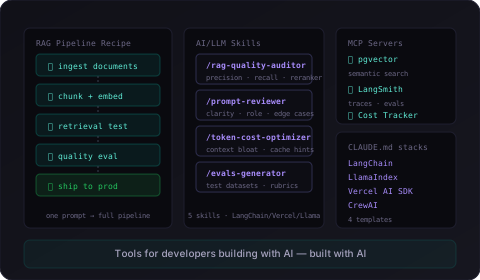
AI/LLM App Developer Toolkit
Tools for developers building with AI — built with AI.
Every company is shipping AI features in 2026. But the existing Claude Code toolkit was built for backend devs, not LLM app developers. This toolkit fills that gap: CLAUDE.md templates for AI stacks, skills that understand prompt engineering, workflow recipes for RAG pipelines and agent debugging, and MCP servers that connect Claude directly to your vector DBs and observability tools.
- LangChain / LangGraph — chain composition patterns, memory management, tool-calling conventions, async gotchas
- LlamaIndex — index types, query engine patterns, node postprocessors, storage context setup
- Vercel AI SDK — streaming patterns, tool definitions, useChat/useCompletion hooks, edge runtime constraints
- CrewAI / multi-agent — agent role design, task delegation, guardrail patterns, shared memory pitfalls
- rag-quality-auditor — evaluates chunking strategy, embedding model fit, retrieval precision/recall, re-ranker need
- prompt-engineering-reviewer — scores prompts on clarity, role definition, output format, and edge case coverage
- token-cost-optimizer — identifies bloated context, suggests caching strategies, estimates cost per 1000 calls
- agent-flow-debugger — maps tool call chains, identifies loops, flags missing error handling in agent logic
- evals-generator — produces test datasets and scoring rubrics for any LLM task (classification, extraction, generation)
- RAG Pipeline Build — document ingestion → chunking strategy → embedding → retrieval test → quality eval → production checklist
- Agent Debugging — reproduce → trace tool calls → identify failure mode → fix → regression test → document
- Prompt Regression Test — snapshot current outputs → change prompt → diff → score degradation → rollback or ship
- LLM Feature Ship — design → build → evals → cost estimate → safety review → feature flag → monitor
- Pinecone Server — upsert, query, list indexes, describe stats; namespace-aware; configurable top-k
- pgvector Server — semantic search against any Postgres table with a vector column; cosine/L2/inner product modes
- LangSmith Server — fetch runs, traces, datasets, and eval results directly into your Claude session
- Helicone / OpenAI cost server — query spend by model, date, user; flag expensive prompts; export cost reports
CLAUDE.md templates also work in Cursor, Windsurf, and any tool that reads project context files. Skills require Claude Code.
Product 9
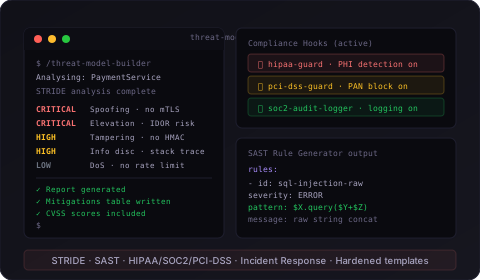
Security / AppSec Pro Toolkit
Advanced security tooling for AppSec engineers and security-conscious teams.
The Dev Pro Skills Pack includes a solid OWASP Top 10 audit — this toolkit goes much further. It's built for security engineers who need threat models, SAST rule generation, compliance enforcement, and structured incident response. Premium pricing is justified: a single security finding caught before prod is worth orders of magnitude more than the cost of this toolkit.
- sast-rule-generator — generates CodeQL / Semgrep rules from a vulnerability description or CVE; outputs rule + test case
- threat-model-builder — STRIDE analysis on any component: data flow diagram, attack surface, mitigations table
- dependency-cve-scanner — deep audit beyond npm audit; maps CVEs to code paths, scores exploitability in context
- security-report-writer — structured findings in two formats: executive summary and full technical report with CVSS scores
- pentest-prep — reconnaissance checklist, attack surface mapping, test plan, and out-of-scope boundary definition
- hipaa-guard — detects PHI patterns (SSN, DOB, MRN, diagnosis codes) in file writes; blocks and logs violations
- pci-dss-guard — blocks writing PANs, CVVs, or cardholder data to non-encrypted files or logs
- soc2-audit-logger — appends an immutable audit log entry for every Claude file write, tool call, and command executed
- secret-pattern-blocker — extended pattern set beyond the base Hook Libraries: AWS, GCP, Azure, Stripe, Twilio, GitHub tokens
- Security Review — threat model → SAST scan → dependency audit → OWASP check → findings report → remediation plan
- Vulnerability Triage — CVE intake → exploitability assessment → affected path mapping → CVSS score → fix or accept decision
- Incident Response — scope → contain → evidence preservation → root cause → timeline → post-mortem doc
- Secure Code Review — STRIDE per component → data flow check → auth/authz audit → crypto usage review → sign-off checklist
- Next.js (hardened) — CSP headers, CSRF protection, auth middleware patterns, secret management, rate limiting conventions
- FastAPI (hardened) — input validation, SQL injection prevention, JWT best practices, CORS policy, dependency pinning
- Django (hardened) — ALLOWED_HOSTS, clickjacking, HSTS, content type sniffing, XSS filter, session security
- Go API (hardened) — input sanitisation, context timeouts, TLS config, structured error responses that don't leak internals
Compliance hooks require review against your specific regulatory obligations before relying on them in production audits. They catch patterns — they are not a substitute for legal review.
Product 10
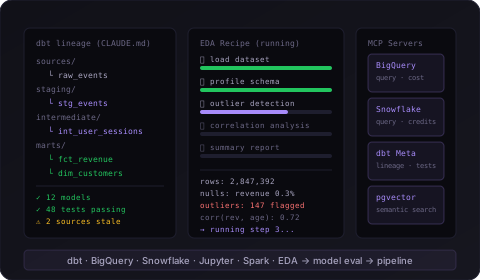
Data & Analytics Toolkit
Claude Code for data scientists and analytics engineers.
The existing toolkits assume a backend developer. Data scientists use entirely different stacks — dbt, BigQuery, Jupyter, Spark, Pandas, scikit-learn — and have entirely different workflows: EDA, model training pipelines, data validation, schema migrations. This toolkit gives Claude the context and tools to work in that world fluently.
- dbt + BigQuery — model naming conventions, ref/source patterns, incremental strategy, test coverage rules, cost-aware query patterns
- Jupyter / Python ML — notebook structure conventions, reproducibility rules, venv/Poetry setup, matplotlib/seaborn patterns, model serialisation
- Spark (PySpark) — partition strategy, broadcast join patterns, UDF pitfalls, caching rules, cluster config gotchas
- Snowflake + dbt — warehouse sizing, clustering keys, time-travel usage, zero-copy cloning, cost guardrails
- BigQuery Server — run queries, list datasets/tables, describe schemas, get query cost estimates, preview results
- Snowflake Server — query execution, schema inspection, warehouse status, credit usage monitoring
- pgvector Server — semantic search, upsert embeddings, cosine/L2 similarity, namespace management (shared with AI/LLM toolkit)
- dbt Metadata Server — fetch model docs, lineage graph, test results, run history, and source freshness status
- EDA Recipe — load → profile (dtypes, nulls, cardinality) → outlier detection → correlation analysis → summary report generated
- Model Evaluation — predictions → metrics (accuracy, F1, AUC) → confusion matrix → error analysis → comparison vs baseline → findings doc
- dbt Model Build — source → staging → intermediate → mart → tests → docs → CI check → deploy
- Data Pipeline Debug — identify failure point → data sample at each stage → root cause → fix → backfill plan → monitoring alert
- schema-change-guard — detects breaking schema changes (column drops, type changes) and requires explicit confirmation before proceeding
- notebook-auto-doc — on session stop, generates a markdown summary of all notebooks touched: purpose, inputs, outputs, key findings
- query-cost-estimator — runs EXPLAIN on BigQuery/Snowflake queries before execution; warns if estimated cost exceeds a configurable threshold
- data-lineage-tagger — appends a lineage comment to every dbt model Claude creates or modifies (source tables, transformation summary)
MCP servers require cloud credentials for your data warehouse. BigQuery Server uses a service account JSON; Snowflake Server uses key-pair auth. Full setup guide included.
Product 11
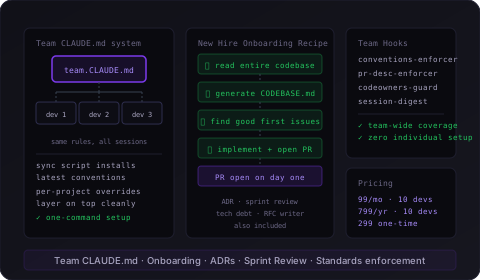
Team & Engineering Leadership Toolkit
Claude Code infrastructure for the whole engineering team.
Every other toolkit is for a single developer. This one scales Claude Code across a team. The team CLAUDE.md system ensures every engineer on the team has the same conventions, rules, and context — without a wiki nobody reads. The workflows automate the high-value, high-effort tasks that engineering leads spend their time on: onboarding, ADRs, sprint reviews, standards enforcement.
- Team conventions template — architecture rules, naming standards, PR norms, and code style — written once, applied across every dev's Claude sessions
- Sync script — pulls the latest team CLAUDE.md from a shared repo location and installs it locally; run manually or as a git hook
- Per-project override system — project-level CLAUDE.md extends the team template without overwriting it; layered inheritance model
- Onboarding installer — single command that sets up a new hire's Claude environment with team conventions, hooks, and project context
- New Hire Onboarding — reads entire codebase → generates personalised CODEBASE.md → identifies good first issues → first PR open on day one
- ADR Generator — decision context → options → trade-off analysis → recommendation → formal Architecture Decision Record doc generated
- Sprint Review — PRs merged this sprint → impact summary → changelog entries → retro prompts → next sprint planning seeds
- Tech Debt Audit — scans codebase → categorises debt (complexity, coverage, dependency age, pattern violations) → prioritised report
- team-conventions-enforcer — validates Claude's file writes against team naming conventions and architecture rules defined in team CLAUDE.md
- pr-description-enforcer — blocks PRs without a description matching the team template; prompts Claude to fill in missing sections
- cross-team-boundary-guard — warns when Claude edits files owned by another team (based on CODEOWNERS); requires explicit confirmation
- session-digest — on stop, generates a structured digest of the session (files changed, decisions made, open questions) formatted for async team comms
- 1:1 Prep — surfaces relevant work, blockers, and growth signals from recent Claude sessions to prepare for team 1:1s
- RFC Writer — problem statement → proposed solution → alternatives → risks → success criteria → stakeholder questions
- Hiring Bar Rubric — generates a structured evaluation rubric for any engineering role based on your team's stack and values
- Post-Mortem Facilitator — timeline reconstruction → contributing factors → blameless analysis → action items → comms draft
What's included
- Team CLAUDE.md system + sync script
- 4 workflow recipes with decision guides
- 4 team standards hooks
- 4 engineering leadership prompts
- Onboarding installer script
- Priority support via email
Product 12
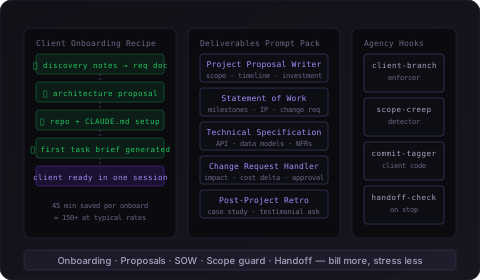
Agency & Freelancer Toolkit
Bill 3 hours of client work in 45 minutes.
Freelancers have the highest motivation of any developer persona to buy productivity tools — every hour saved is direct revenue. This toolkit treats Claude Code as a business tool, not just a coding assistant. Client onboarding, proposal writing, scope management, deliverable generation, and handoff documentation: all the work that surrounds the code, automated.
- Client Onboarding — discovery call notes → requirements doc → architecture proposal → repo setup → CLAUDE.md → first task brief, all in one session
- Project Scoping — feature request → effort breakdown → risk list → assumptions log → SOW section → timeline estimate
- Project Handoff — generate CODEBASE.md, deployment guide, environment setup docs, and a client-readable feature summary for any project
- End-of-Sprint Report — commits this sprint → plain-English summary → blocked items → next sprint plan → client-ready status update
- Project Proposal Writer — problem statement, proposed solution, deliverables table, timeline, investment, and next steps — client-ready in one prompt
- Statement of Work — scope, out-of-scope list, acceptance criteria, payment milestones, change request process, IP ownership clause
- Technical Specification — architecture overview, API contracts, data models, integration points, non-functional requirements
- Post-Project Retrospective — what went well, what didn't, lessons learned, client testimonial prompt, case study draft
- Change Request Handler — impact analysis, effort delta, revised timeline, updated cost — structured for client approval
- Multi-client conventions — client-code prefixed branches, commit message client tagging, per-client env file naming, project isolation rules
- Quality standards — client-facing code standards, documentation requirements, test coverage expectations, handoff checklist Claude must complete
- Business context — billability awareness, scope boundary rules, "don't over-engineer for a fixed-price project" guardrails
- Communication templates — formats for technical explanations at non-technical client level, decision log structure
- client-branch-enforcer — validates branch names include the client code prefix; blocks misnamed branches before they hit remote
- scope-creep-detector — flags new requirements appearing mid-session that aren't in the original brief; prompts Claude to log them separately
- client-commit-tagger — auto-appends client project code to commit messages for accurate time tracking and invoicing audit trails
- handoff-checklist — on session stop for client projects, verifies CODEBASE.md is current, .env.example is complete, and README has deployment steps
Works with any client project stack. The CLAUDE.md template and hooks are stack-agnostic. Workflow recipes use Claude Code's file read capabilities — no external integrations required.
Product 13
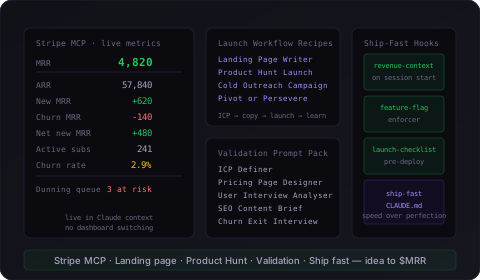
Indie Hacker / Solo Founder Toolkit
Idea to launch, solo. Ship fast, validate faster.
Solo founders and indie hackers have a unique constraint: one person doing the work of five. This toolkit is built around that reality — ship-fast conventions, business metrics in Claude's context, launch automation, and validation frameworks that tell you whether to keep building or pivot before you've wasted six months. The first toolkit on ClaudeKit that treats your business as seriously as your code.
- Revenue dashboard — MRR, ARR, new MRR, churn MRR, net revenue retention — queried directly from Claude Code
- Customer queries — look up any customer, their plan, payment history, and lifetime value without leaving your session
- Churn analysis — list recently churned customers, cancellation reasons (if captured), and cohort churn rates
- Upgrade/downgrade tracking — which customers moved plans and when; expansion revenue breakdown
- Failed payment alerts — fetch dunning queue, retry status, and estimated recoverable revenue
- Landing Page Writer — ICP definition → headline variants → hero copy → feature bullets → social proof placeholders → CTA → meta tags, all generated
- Product Hunt Launch — tagline options → description → first comment → maker story → hunter outreach message → upvote ask template → launch day checklist
- Cold Outreach Campaign — ICP research → 10 personalised cold DMs → follow-up sequence → objection responses → conversion tracking setup
- Pivot or Persevere — analyse usage data, revenue trend, and user feedback → structured decision framework → recommendation with evidence
- ICP Definer — from your product description, generates 3 ICP candidates with demographics, pain points, willingness to pay, and where to find them
- Pricing Page Designer — value metric selection, tier structure, anchoring strategy, FAQ objections — structured for a SaaS pricing page
- User Interview Analyser — paste raw interview transcripts → extract key pain points, feature requests, buying triggers, and jobs-to-be-done
- SEO Content Brief — keyword cluster → content outline → internal link suggestions → estimated traffic potential → meta copy
- Churn Exit Interview — structured questions to uncover real cancellation reasons, with a winback offer decision tree
- Ship-fast CLAUDE.md — conventions prioritising delivery speed: no premature abstraction, inline what fits on one screen, feature flags over refactors, done over perfect
- revenue-context hook — on session start, fetches MRR and active subscriber count from Stripe MCP and prepends to context so Claude always knows the business state
- feature-flag-enforcer — encourages wrapping new features in flags before shipping; warns when Claude writes code that can't be toggled off in production
- launch-checklist hook — on session stop before a deploy, runs through: analytics tagged, error tracking live, legal pages exist, emails sending, Stripe live mode active
Stripe MCP Server requires a Stripe API key (restricted read-only key recommended). Works with any Stripe account — test and live mode supported. Full setup guide included.
Product 14
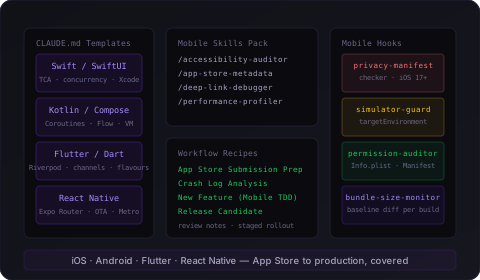
Mobile Developer Toolkit
Claude Code for iOS, Android, and cross-platform mobile.
Every existing toolkit in the ClaudeKit suite assumes a web or backend developer. Mobile development has a completely different set of conventions, gotchas, and workflows — App Store submissions, provisioning profiles, simulator vs device behaviour, accessibility requirements, deep links, push notifications, and platform-specific performance traps. This toolkit teaches Claude all of it, for every major mobile stack.
- Swift / SwiftUI — App architecture (MVVM, TCA), Swift concurrency patterns, SwiftUI lifecycle gotchas, Xcode build system rules, memory management
- Kotlin / Jetpack Compose — Compose recomposition traps, Coroutines + Flow patterns, Navigation component, ViewModel lifecycle, ProGuard rules
- Flutter / Dart — widget tree optimisation, state management (Riverpod/Bloc), platform channel conventions, build flavour setup, hot reload limitations
- React Native (Expo) — Expo Router patterns, native module bridging, OTA update strategy, Metro bundler config, platform-specific code conventions
- accessibility-auditor — VoiceOver/TalkBack audit: missing labels, colour contrast failures, touch target sizes, dynamic type support, focus order issues
- app-store-metadata-generator — App Store / Play Store title, subtitle, description, keywords, what's new copy — keyword-optimised and character-count aware
- deep-link-debugger — traces Universal Links / App Links / custom scheme routing, identifies missing entitlements, tests intent handling
- performance-profiler — identifies frame drop causes, Instruments-style analysis, FlatList/LazyColumn optimisation recommendations, image cache strategy
- App Store Submission Prep — screenshots checklist → privacy manifest → entitlements audit → App Store Connect metadata → TestFlight build → review notes
- Crash Log Analysis — symbolicated crash → root cause hypothesis → reproduction steps → fix → regression test → release note
- New Feature (Mobile TDD) — UI spec → widget/compose test → implement → snapshot test → accessibility check → device matrix verification
- Release Candidate — version bump → changelog → build → internal testing → beta → staged rollout plan → monitoring dashboard setup
- privacy-manifest-checker — validates that any new API usage (location, camera, contacts, tracking) has a corresponding PrivacyInfo.xcprivacy entry before commit
- simulator-guard — detects simulator-only code paths being committed without a #if targetEnvironment guard; warns on simulator-specific workarounds
- permission-usage-auditor — scans for permission requests and verifies usage description strings exist in Info.plist / AndroidManifest for every permission used
- bundle-size-monitor — after build, compares binary size against last commit baseline; warns if size increases beyond configurable threshold (default: 5%)
Platform coverage
- iOS / iPadOS (Swift + SwiftUI)
- Android (Kotlin + Jetpack Compose)
- Flutter (iOS + Android)
- React Native / Expo (iOS + Android)
- macOS Catalyst (via SwiftUI template)
Best value
Get all 14 toolkits for $149
The Complete Toolkit — every skill, hook, recipe, MCP server, and starter kit, with updates included.
30-day refund guarantee · Instant download
Get the Complete Toolkit — $149 →